#1626 detent
feat(admission): surface pending proposals
You mark an issue Todo. Detent claims it, runs it against the contract you checked in, and moves it between the states your workflow defines, holding it wherever you put a gate. Every issue it manages sits at a named state on the board.
You are not steering an agent; you are running your own engineering process at scale.
brew install digitaldrywood/tap/detentNo signup. No hosted plan. v0.114.50 · MIT · you bring the model cost.
feat(admission): surface pending proposals
feat(health): surface stranded active work
chore(safety): guard dispatch capacity paths
fix(scheduler): clean orphan cycle state
fix(orchestrator): add token progress brake
fix(board): collapse staleness warnings
docs(cli): refresh version output example
test(project): relax watcher deadlock guard
The six lanes shown come from Detent's own production configuration, not a fixed product state model; each workflow defines its own states. This is not a live board: the issue numbers and titles come from real merged work in digitaldrywood/detent, composed across the path for this illustration. The counts describe the illustration; 785 is the all-time landed pull requests on that repository. Non-code workflow example →
"Manage work, not agents" is OpenAI Symphony's phrase. Detent grew out of that open spec and took the idea from spec to a shipped system.
Symphony is an Apache-2.0 SPEC.md plus an Elixir reference implementation that polls a Linear board.
openai/symphony ↗Detent began as an Elixir/OTP implementation adapted from Symphony's Linear target to GitHub Projects v2. It is now a ground-up Go rewrite; that earlier implementation is archived.
A detent is the catch that holds a moving part at a defined position until it is deliberately released: the click-stop on a dial, the notch on a ratchet. It does two things at once. It resists movement out of a position, and it makes the set of positions definite. Detent is named for the second one.
The board above and the lane rail below are the visible form of the claim: managed work sits at a state the workflow defines, rather than somewhere inside a session you have to read to locate.
Autonomy-first tools put the intelligence in the agent and ask you to supervise it. Detent puts the intelligence in your spec and supplies the discipline. Same task, two interaction models.
The goal is not to replace engineers or hide work behind opaque behavior. It is to scale the judgment of engineers who already have a high bar. The system does not try to be smarter than you; it tries to be as disciplined as you would be, every time, in parallel.
Configured GitHub status is the state machine. A ProjectV2 board, a boardless issue Status field, or repository status labels all drive it.
The notch marks a gate you defined. Lanes are workflow-defined: this is the delivery path. Detent's own board also configures Backlog, Blocked, and Cancelled.
Each project has a checked-in detent.yaml machine contract — tracker bindings, states, lifecycle policy, scheduling, retries, leases, gates — plus a checked-in, portable WORKFLOW.md agent instruction contract.
Detent claims it, creates an isolated Git worktree from your source checkout, and dispatches a Codex agent with the contract — moving the issue to In Progress.
In its own branch. It runs your validation gate and opens or updates a pull request.
The workflow decides whether promotion to Merging waits in Human Review, waits in the active lane, requires a current-head automated PR review, or only needs linked PR + green CI + quiet time.
One rebase, CI-watch, and merge at a time, so concurrent candidates never invalidate each other's CI. Then the issue is Done.
A global.yaml runs multiple projects with weights, priority, pause, and fair scheduling.
Serialized: one rebase, one CI watch, one merge at a time. Ten agents working in parallel never invalidate each other's CI, because only one candidate is ever being tested against the head that will receive it.
Train width is configuration, not doctrine — Detent runs its own board at one candidate at a time. The guarantee that follows is narrow and worth stating plainly: a merge only happens after CI passed on the exact commit that is about to land. Merge train configuration →
Live counts, running agents, token / budget / rate-limit state, board flow, timelines. "In progress" means an agent is actually working right now.
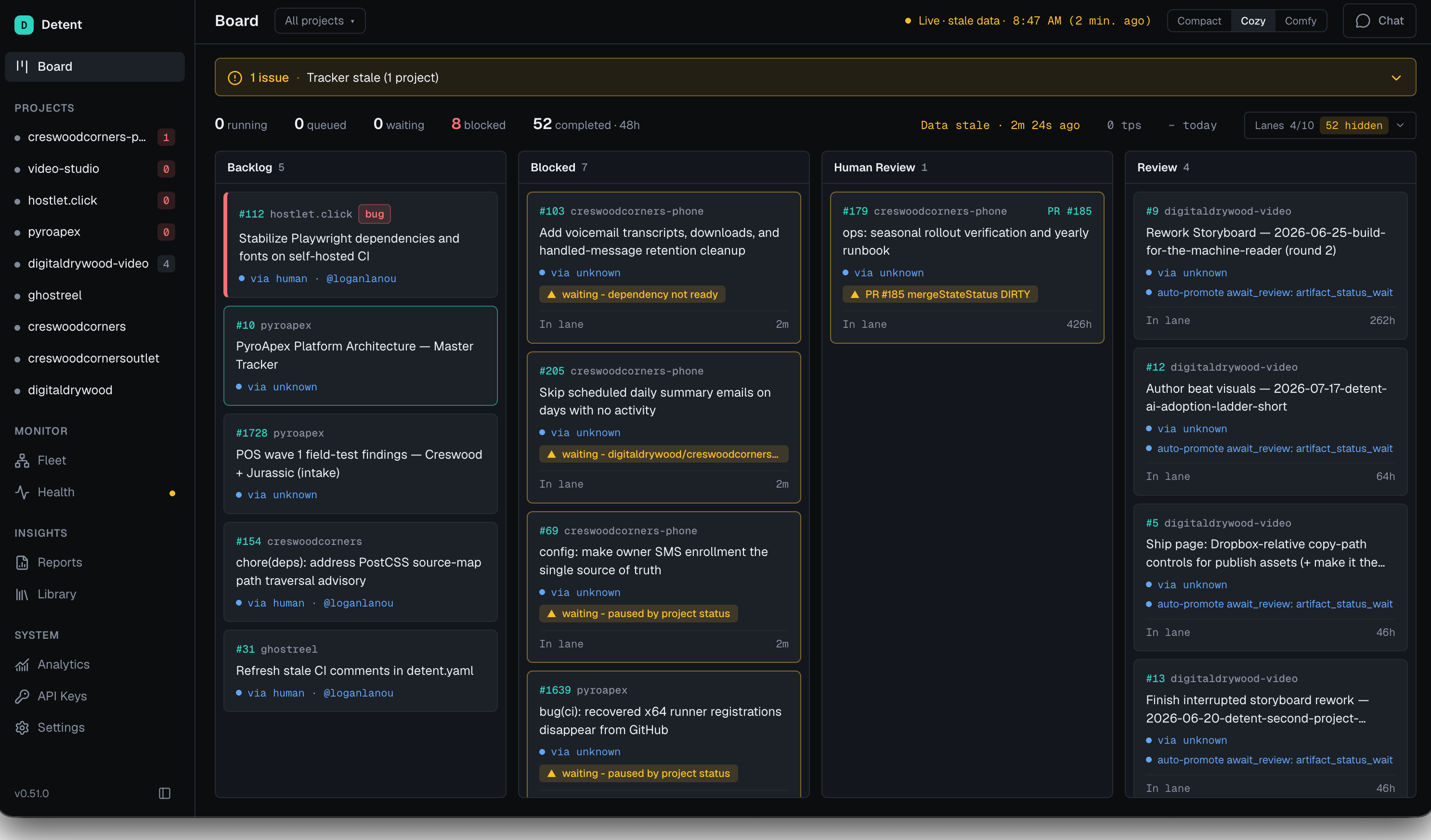
detent  ·  9 projects  ·  running  ·  held  ·  budget and rate limit in the header
 ▸ In Progress   agent working, make check …
 ▸ Human Review  held: approval label
 ▸ Merging       train: rebased, CI watch
And a terminal UI for people who live in tmux — the same lanes, the same counts, no browser.
Tour the operator surface →Two files, checked into your repository: the machine contract and the agent contract. Both are excerpted here from Detent's own production config.
tracker:
     kind: github
     github_status_source: label
     repository: digitaldrywood/detent
     status_label_prefix: "detent:"
     active_states:
         - Todo
        - In Progress
        - Rework
        - Merging
     terminal_states:
         - Done
        - Cancelled
     dependency_auto_unblock:
         enabled: true
         target_state: Todo
readiness: terminal_or_mergedYou are working on **Detent** — a Go agent-orchestrator
delivered as a single binary — on GitHub issue
{{ issue.identifier }}.
## Detent Protocol
Keep one persistent ## Codex Workpad issue comment
updated with the plan, validation evidence, blockers,
and final handoff. Every update must contain one
detent-status signal.
Follow CLAUDE.md and AGENTS.md; they are the project
authority for layout, formatting, validation, and
review conventions.Gitignored detent.local.yaml and WORKFLOW.local.md apply machine-specific overrides without touching the shared contracts. You can keep reading by hand too; nobody will revoke your keyboard.
digitaldrywood/detent-orchestration is Detent's own production config. It dispatches the agents that build Detent, and the merged pull requests shown on this site were written by agents it dispatched.
It is copyable as a template for your first project.
Copy the template ↗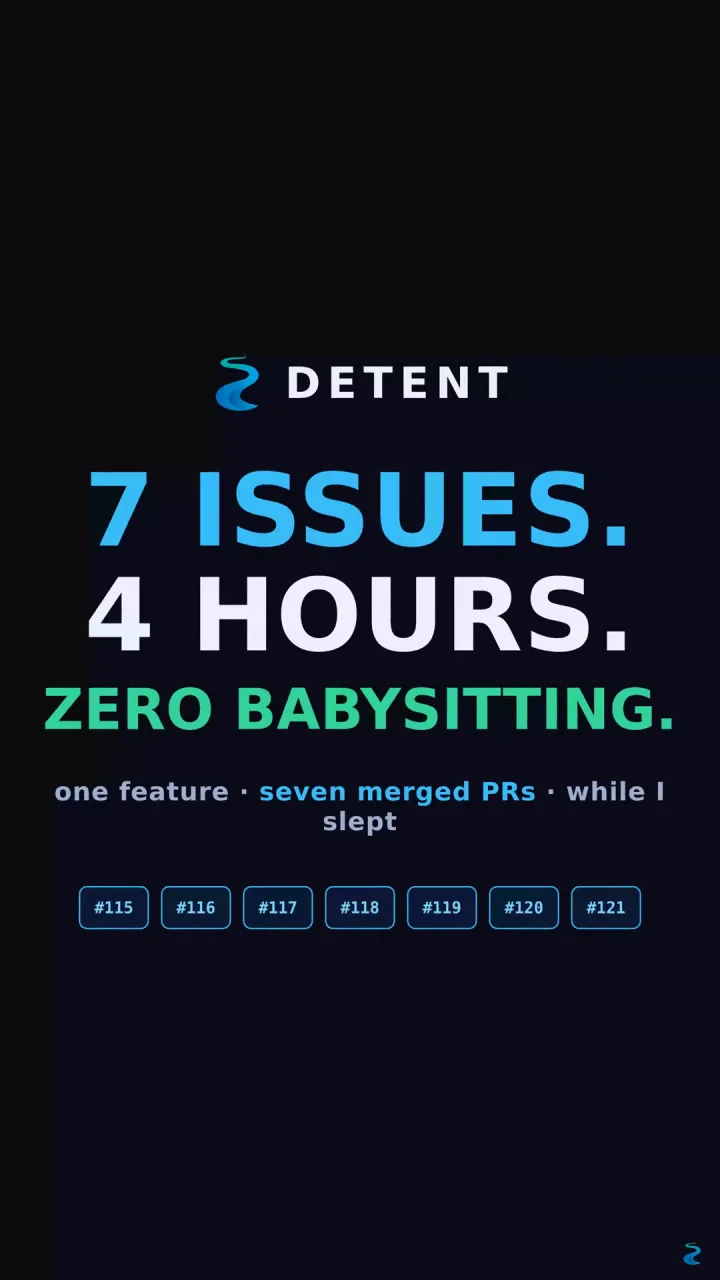
One feature. Seven real issues. Four hours. Zero babysitting.
A global.yaml runs many projects with weights, priority, pause, and fair scheduling. Below is the projects block of Detent's own.
The projects block of Detent's own global.yaml. That file also sets max_concurrent_agents: 10, strict scheduling, and a 1h fair-share half-life. Budget caps and rate-limit state live on the dashboard. Multi-project operation →
macOS, Linux, and Windows. Install it, run the preflight check, and point it at a repository.
Homebrew — recommended when you already manage CLI tools with brew
brew install digitaldrywood/tap/detentOr build from source with Go
go install github.com/digitaldrywood/detent/cmd/detent@latestUpgrade with brew upgrade digitaldrywood/tap/detent.
$ detent doctor         # preflight: gh, codex, token scope, config discovery
 $ detent version        # binary version, commit, and build date
 $ detent update --check # checksum-verified self-update