Skip to content
Open source

MIT. Free. Self-hosted. No control plane.

There is no hosted tier, no per-seat charge, and nothing to sign up for. You bring the model cost, and that is the whole business model.

01 · The terms

Short version, on one screen.

Detent runs fully local and is air-gappable. It has no vendor control plane, which means there is no service that can revoke your access, change your pricing, or read your board. The trade is that operating it is your job.

02 · Proof

It ships itself.

digitaldrywood/detent-orchestration is Detent's own production config. It dispatches the agents that build Detent, and the merged pull requests shown on this site were written by agents it dispatched.

It is copyable as a template for your first project.

Copy the template ↗
I Opened Seven Issues for One Feature (On Purpose) video thumbnail
2026-07-02 · 2:20 · Detent v0.20.1

I Opened Seven Issues for One Feature (On Purpose)

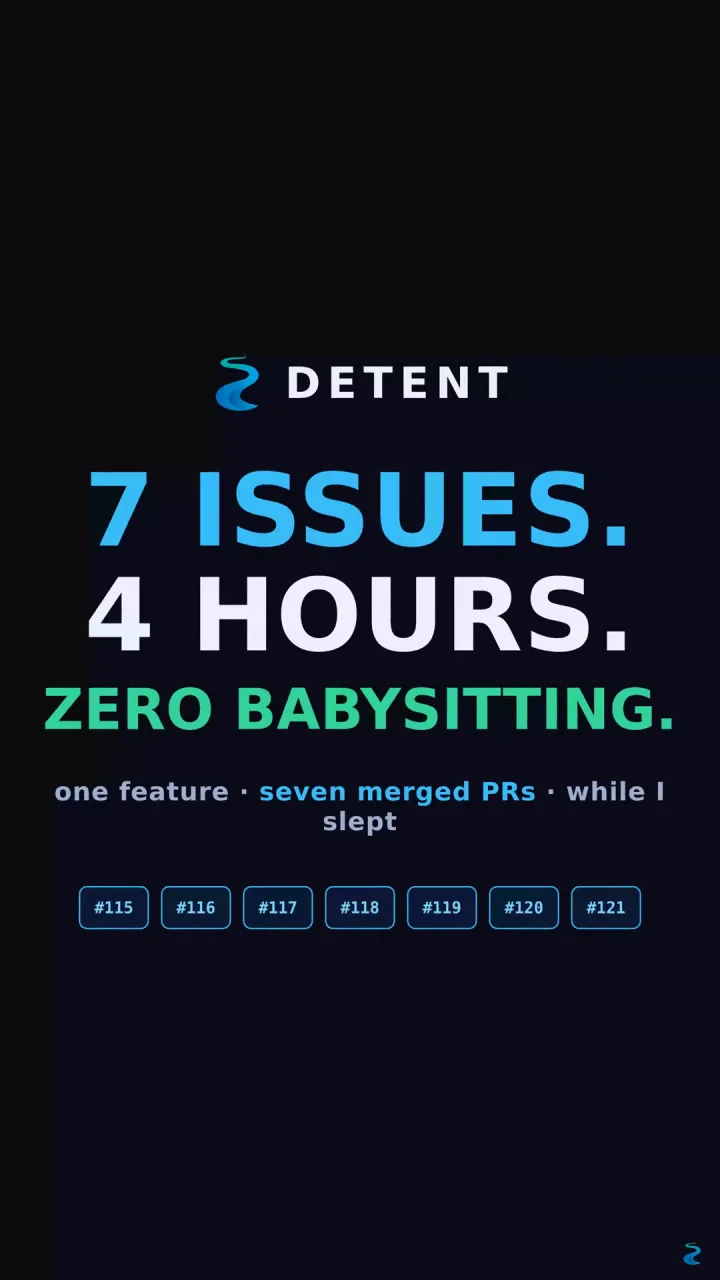
One feature. Seven real issues. Four hours. Zero babysitting.

Demonstrates
  • A seven-issue dependency graph completed in merge order.
  • Detent returned dependent work to Todo after its prerequisite merged.
03 · Proof points

Claims the repository can substantiate.

Every line here maps to something checked in, released, or running. Nothing on this site is a projection.

One CGO-free Go binary

macOS, Linux, and Windows. go install, Homebrew, Winget, Scoop, .deb, .rpm, or copy a single file. No service to stand up.

Self-hosted, air-gappable

Runs fully local. There is no Detent vendor control plane and no Detent telemetry — the only outbound traffic is to your tracker and your model provider.

Deterministic gated merge train

Serialized rebase, CI-watch, and merge — one candidate at a time, so what lands is always green.

Multi-instance fleet governance

Many projects from one host with weights, priority, pause, and fair scheduling.

Budget and cost caps

Token, budget, and rate-limit state live on the dashboard, with caps you configure.

Pluggable validation gates

Code defaults to make check plus CI plus automated review. A human approval-label gate is available when the workflow asks for one.

detent doctor preflight

Cross-platform config discovery, a GoReleaser pipeline, and checksum-verified self-update.

MIT licensed, free

You bring the model cost. Nothing else is metered.
And the honest caveats

  • Code is the proven domain. The same status-to-gated-review-to-done shape is the trajectory for non-code work — validation gates are already pluggable, but non-git and non-PR deliverables remain follow-up work.
  • Model-agnostic is partial, not done. Codex is the shipped backend; the routing seam exists and Claude Code is supported per role, but this is a ◐ in the matrix, not a ✓.
  • Release signing is not finished. Self-update verifies published SHA-256 checksums over GitHub TLS; enforcement of detached minisign signatures is gated until the binary embeds a pinned public key.
  • It is a young project. Judge it on the version history, the CI badge, the installer smoke tests against real release assets on Ubuntu and Windows, and the fact that it builds itself — not on a logo wall, because there is not one.
04 · Lineage

Where this came from.

"Manage work, not agents" is OpenAI Symphony's phrase. Detent grew out of that open spec and took the idea from spec to a shipped system.

What Symphony is

Symphony is an Apache-2.0 SPEC.md plus an Elixir reference implementation that polls a Linear board.

openai/symphony ↗

Where Detent diverged

  • One binary. One CGO-free Go binary for macOS, Linux, and Windows, with no BEAM service to stand up.
  • GitHub-native state. ProjectV2, boardless issue-field mode, boardless label mode, or the github_local hybrid mode keep the work in GitHub's issue and pull request ID space.
  • Fleet scheduling. Multiple projects from one host, with weights, priority, pause, and fair scheduling.
  • Configurable gates. Configurable gates plus a serialized merge train that validates the exact commit about to land.
  • Operator surface. A dashboard, terminal UI, detent doctor, cross-platform config discovery, and a GoReleaser pipeline.

Detent began as an Elixir/OTP implementation adapted from Symphony's Linear target to GitHub Projects v2. It is now a ground-up Go rewrite; that earlier implementation is archived.

05 · Contributing

The same gates apply to you.

Detent's board dispatches agents against its own contracts, and human pull requests go through the same validation gate and the same merge train.

Keep reading